PRESINMED — Preserving the singularity of Mediterranean high-mountain biodiversity hotspots: a Nature-based Solutions approach — is a three-year transnational project (March 2025 – February 2028) funded through the Biodiversa+ 2023–2024 joint call Nature-based solutions for biodiversity, human well-being and transformative change (BiodivNBS).
Background
With just 25% of the emerged land, mountain regions sustain more than 85% of the world’s mammal, amphibian and bird species, many of them endemic to mountains. Mediterranean mountains are also hotspots of endemic vascular plants. Protecting mountain areas is therefore a key strategy to reverse global biodiversity decline, and long-term conservation depends on timely management based on relevant data and models to monitor, restore and anticipate the responses of mountain ecosystems to multiple stressors.
Mediterranean mountains are especially exposed to climate change: they face the double hazard of being mountains and of lying next to the semi-enclosed, relatively shallow Mediterranean basin. Climatic variability and summer drought are expected to increase while snow cover duration decreases. Because biological activity here is limited both by winter cold and summer drought, the winter–summer transition will become faster and harsher, shortening and reshaping the period of biological activity.
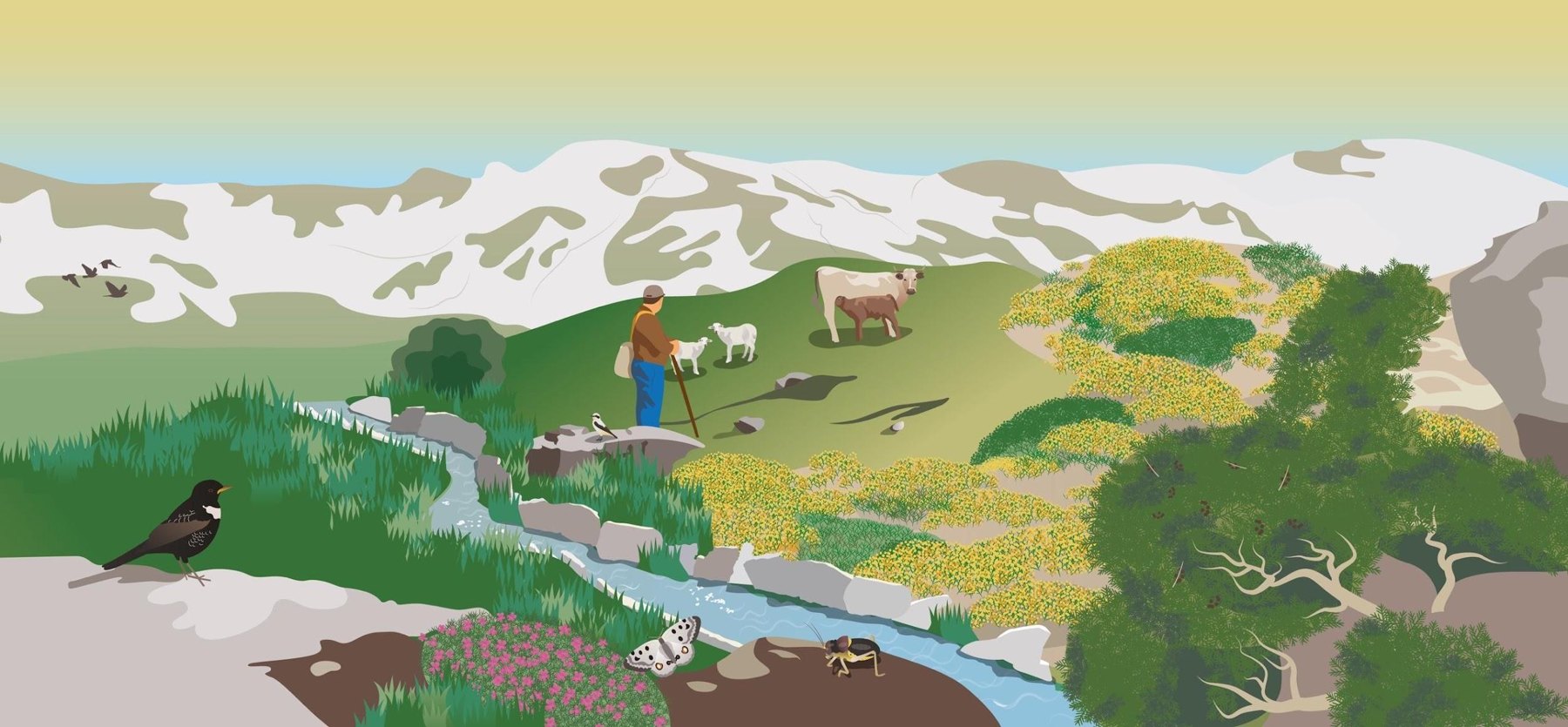
Why wet meadows and snowbed grasslands matter
High-mountain wet grasslands host megadiverse communities and support numerous ecosystem services:
- Unique ecosystems, rich in endemic species.
- Water regulation, increasing the duration and availability of water in the watershed through infiltration and irrigation.
- Food sovereignty, through highly productive pastures and crops.
- Ecological resilience against environmental risks, reducing erosion and landslides.
- Social resilience and sustainability, thanks to their multifunctionality.
- Cultural heritage linked to agroecosystems with a long historical tradition and a strong influence on culture, tourism and local economies.
Threats
- Aridification. Warmer temperatures and lower precipitation reduce the extent and duration of snow cover and water inputs to wet meadows. A longer window of biological activity increases evapotranspiration and intensifies summer drought, with cascading ecological effects. Shrinking wet patches lose connectivity and behave like islands in a dry matrix, losing (mostly endemic) species and increasing inbreeding.
- Concentration of wild and domestic ungulates, with associated consumption, trampling, fertilisation and seed dispersal — including of invasive species. Fewer and smaller wet “islands” mean even higher pressure per square metre.
- Tourism pressure, which concentrates on grasslands that remain green in summer and on gentle snowy slopes in winter, bringing trampling and litter.
Guiding hypothesis. The increase in temperature and, above all, the reduction in water availability and snow cover should differentially affect Mediterranean mountain wet meadows and snowbed grasslands: mountains with a more temperate and rainy summer will be less affected than mountains with a more Mediterranean and semi-arid climate.
Objectives
Main objective. To diagnose and mitigate the real impact that climate change (mostly drought), in combination with local drivers (herbivory and tourist pressure), is having on the megadiverse humid ecosystems of Mediterranean high mountains — and to use site-specific Nature-based Solutions to maintain and restore their biodiversity and ecological functions.
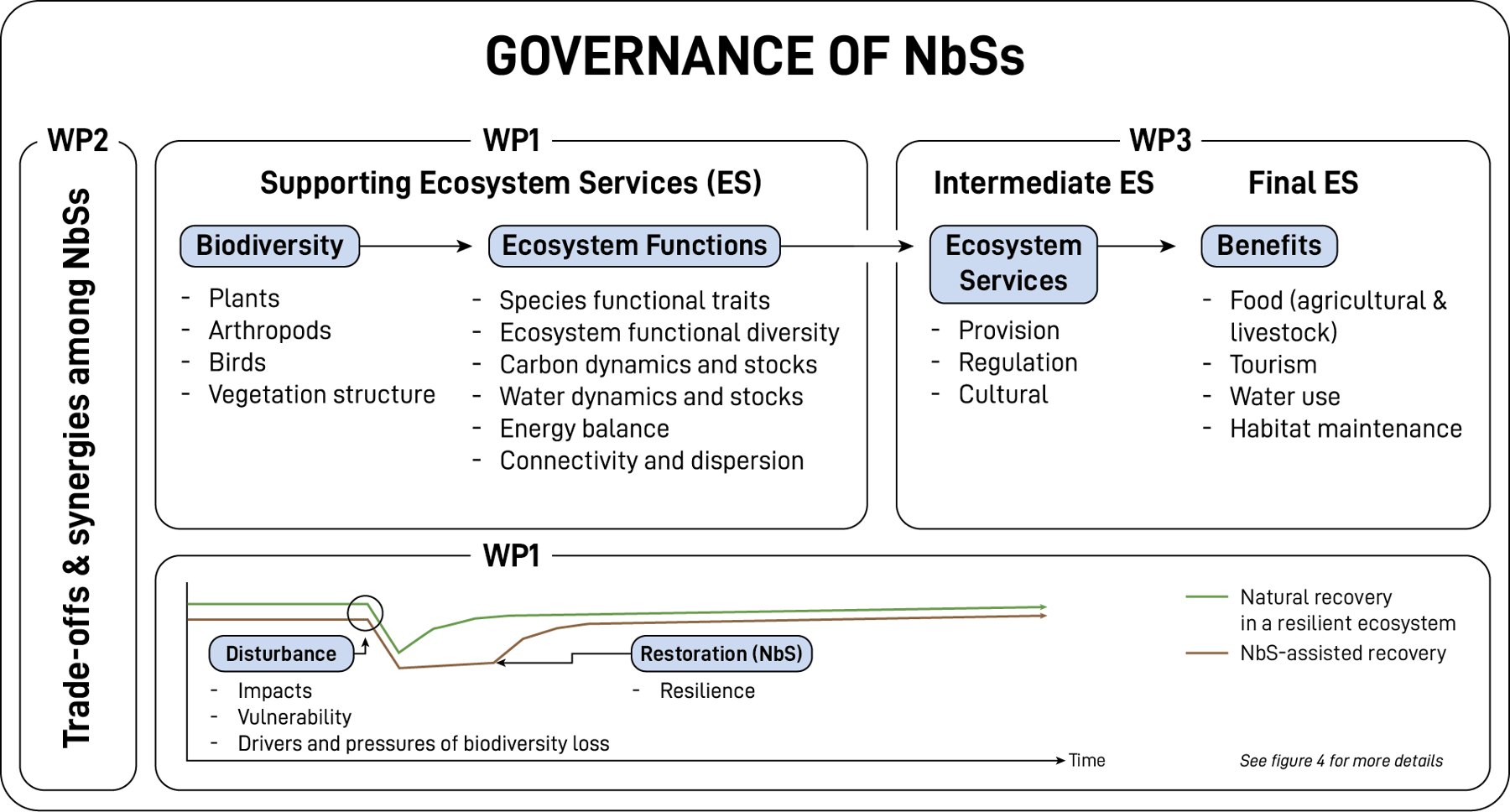
We analyse ecological responses and community dynamics, using essential ecosystem variables as indicators, across a large gradient of conditions (acid or base-rich substrates, local climate, land-use type). The natural post-drought recovery of meadows (passive restoration) is compared with specific actions that may accelerate recovery (active restoration).
As a result, PRESINMED will identify and create climate-resilient green infrastructures and associated science–policy–society–enterprise interfaces. NbS will help mitigate multiple mountain hazards — reduced water availability, landslides, water stress, food insecurity — while generating co-benefits such as biodiversity conservation, income opportunities, recreation and carbon sequestration.
The project goals are organised in three work packages:
WP1 · Assess
Assess the health of wet meadows and snowbed grasslands using remote sensing, ICT and AI to develop essential variables and an integrated diagnosis.
WP2 · Act
Implement mitigation, adaptation and restoration measures with NbS, combining scientific and local knowledge in exportable pilot projects.
WP3 · Transform
Contribute to transformative societal change through collaboration, training, open information and shared governance across the Mediterranean.
Research questions
- To what extent do Mediterranean high-mountain wet meadows and snowbed grasslands lose area and connectivity under intensified summer drought?
- How could rising temperatures and drought alter the phenology of these habitats, shorten the growing-reproductive period and compromise species survival?
- What are the ecological consequences of herbivory and tourism on wet and snowbed grasslands — and what carrying capacity of herbivores and visitors can they support?
- What are the taxonomic and functional traits of winner and loser species under global (climate) and local (herbivory, visitors) drivers?
- What are the consequences of these changes for ecological interactions and processes?
- How can essential biodiversity variables be derived from field surveys, automated instruments, ecohydrological models and remote sensing?
- Which passive and active NbS can be co-designed with managers and local communities to preserve these hotspots under global change?
- What are the effects of irrigation, grazing and exclusion on biodiversity, water and carbon balance?
- What trade-offs and synergies exist among NbS and among the ecosystem services provided by wet meadows?
- How can participatory water governance foster the resilience of wet meadows while remaining compatible with agriculture, livestock and tourism?
Study design
To answer these questions we study a broad gradient of wet meadows and snowbed grasslands in a representative sample of Mediterranean high mountains: Sierra Nevada (Spain), Serra da Estrela (Portugal), the Apennines and Gran Paradiso (Italy), and the High Atlas (Morocco). They were chosen as representative of contrasting:
- socio-ecological conditions — from heavily to barely grazed, and from highly to seldom visited;
- ecosystem typologies and services;
- water and natural-resource management plans;
- environmental and climatic conditions; and
- land-use types.
Because the problems we address are shared by most high mountains, this multi-site design allows us to generalise results and make predictions for similar Mediterranean and semi-arid contexts.
Connections
PRESINMED builds on long-term research and monitoring in Mediterranean mountains (e.g. LIFE Adaptamed, SmartEcoMountains, Ecopotential and MEMOLA in Sierra Nevada; ESTRELA and REMONSTAR in Serra da Estrela) and on permanent collaboration with international initiatives such as GLORIA, eLTER, LifeWatch ERIC, GEO BON, the Mountain Research Initiative and UNESCO-MAB.
